

Transparency Framework
Assessment
Summary
Learn about our student learning outcomes and our transparency framework.
Affordable
$295 per credit hour
Accredited
Accredited by HLC & ABHE
Convenient
Can be done entirely online
Transferable
Classes can transfer
Transparency Framework
Overview
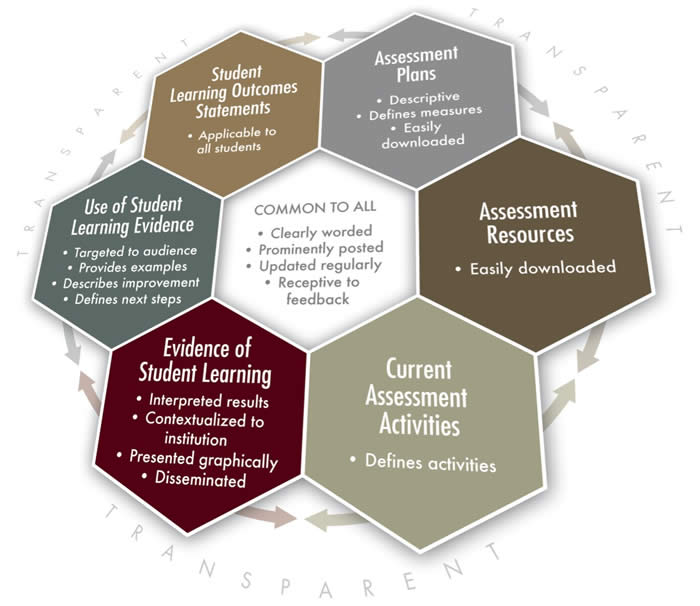
The NILOA transparency framework is comprised of six sections.
- Student learning outcomes statements
- Assessment plans
- Assessment resources
- Current assessment activities
- Evidence of student learning
- Use of student learning evidence
Student Learning Outcomes Statements
Assessment Plans
Direct measures require students to demonstrate the knowledge, skill or disposition that is being assessed. So a direct measure of math would include, say, addition problems.
Indirect measures focus on things related to the knowledge, skill or disposition being assessed. So an indirect measure of math might ask students to rate their own math ability on a 5-point
Assessment Resources
If you are unfamiliar with
Assessment of student learning means what it sounds like: are a college’s classes and degree programs effectively helping students learn and develop? This is an important question for students and
Of course, there are lots of individual benefits from college – things like new friendships, mentoring from faculty and staff, cultural experiences, perhaps even meeting a spouse – that don’t get included in
GBSC is committed to transparency in our assessment of student learning. This is demonstrated by our use of the transparency framework developed by the National Institute for Learning Outcomes Assessment (NILOA), a leading organization in student-learning accountability.
Assessment of institutional effectiveness has to do with how well a college is functioning. Are offices effectively accomplishing their tasks? Are services being offered
What is
Tools include tests, surveys, inventories, checklists, anecdotes and more: these make up the toolbox for measurement, which means quantifying something (it could be behavior, effectiveness, knowledge or many other things).
Standards and goals need to be established prior to measurement. This gives a sort of “yardstick” that can be used in
The term assessment is also used broadly to include a cycle involving both assessment and evaluation.
What is evaluation?
The assessment cycle or loop
In discussions of assessment, you may often hear talk about “closing the loop.” What loop is this?
The cycle starts with program implementation – teaching a class, offering a degree program, operating an office, etc.
After (or during) implementation, assessment takes place (remember, this means measuring something for which goals have already been established).
Once assessment results are available (and typically after implementation has concluded an iteration or phase), results are used to make an evaluation about how effective the implementation was. What was good? What could be improved?
Based on
Assessment Tools
This section focuses on providing resources to staff and faculty.
Unfortunately, most attention is paid to the academic side of assessment, so no links here are provided to resources related to assessing institutional effectiveness other than this one: the Professional and Organizational Development (POD) Network maintains useful resources, especially their very active email list. Questions in that area may be directed to GBSC’s Director of Institutional Research.
“Authentic assessment” resources
- Authentic assessment toolbox (Jon Mueller)
- Critical Incident Questionnaire (Stephen Brookfield)
Website for Helen Barrett,portfolio expert
General
- Assessment and rubrics (Kathy Schrock)
- Collected Essays on Learning and Teaching: includes assessment section
- Collection of resources (Iowa State University)
- Assessment Resources (North Carolina State University)
- Designing Learning and Assessment in a Digital Age (JISC)
- Resources for Assessing Student Learning (University of North Carolina at Chapel Hill)
- Writing outcomes (Leslie Wilson)
Rubrics
- Assessment and rubrics (Kathy Schrock)
- Creating and Using Rubrics
- VALUE rubrics (AAC&U)
- Rubrics (University of Colorado Boulder)
Traditional assessment
- Exam Design (University of Texas at Austin – Faculty Innovation Center)
- Best Practices for Designing and Grading Exams (University of Michigan)
How to Look at Multiple-Choice Assessments Formatively (Edutopia)- Question Types (University of Texas at Austin – Faculty Innovation Center)
- Designing Multiple-Choice Questions (University of Waterloo –
Centre for Teaching Excellence)
Current Assessment Activities
Activities listed here are used regularly, with some rotation cycles. Typically seniors complete the same assessments they took as freshmen, enabling longitudinal analysis.
Evidence of Student Learning
Developing evidence of student learning is an ongoing activity at GBSC. See reports below:
- Fall 2025
- Spring 2025 (General Education)
- Fall 2024
- Spring 2024 (General Education)
- Fall 2023
- Spring 2023 (General Education)
- Fall 2022
Additional assessment information is available on our School Stats page.
Use of Student Learning Evidence
GBSC periodically collects examples of changes based on assessment results. Typically these results feed into course, program and institutional reviews of effectiveness. They may drive change at any of these levels (e.g., different textbooks or assignments, revisions of required courses, etc.).
Contact Our Office
- Email – [email protected]
- Call – (513) 763-6565
- Text – (513) 402-chat (2428)